About the author: Mason Zhao — Hefei Chenhui Defense Technology Co., Ltd. (合肥辰辉防务技术有限公司), a company focused on electro-optical counter-surveillance and counter-sniper technologies for VIP protection and the security of key sites. If you work in protective security, critical infrastructure protection, or defence and police procurement and would like to discuss the underlying physics, the operating conditions and the evaluation methodology in more detail, we are glad to continue the conversation.
Understanding How Hidden Optics Are Detected
Most security systems look for something that is emitted — a radio signal, a heat signature, a network packet. Optical observation equipment emits none of these. This article explains how one branch of electro-optics turns that advantage against the observer, and where the limits are.
1. The quietest tool in the reconnaissance kit
A person watching a compound through a spotting scope, a rifle scope or a long telephoto lens is doing something that is remarkably hard to detect. The device does not transmit. It does not radiate. It simply gathers the light that is already there.
That is why optical observation sits at the heart of what the UK's National Protective Security Authority (NPSA) calls hostile reconnaissance: "purposeful observation with the intention of collecting information to inform the planning of a hostile act against a specific target." NPSA's counter-reconnaissance framework is built on three verbs — deny the hostile the information, detect them while they are collecting it, and deter them. The middle verb is where electro-optical counter-surveillance lives.
2. Why conventional detection struggles
- No emissions.RF monitoring and spectrum analysis find transmitters. A telescope is not one.
- Thermal imaging sees bodies, not intent.An infrared camera may show a warm object at distance. It cannot tell you that a lens is pointed at your principal.
- Radar is a different problem.It addresses reflective or moving targets; it is not designed to identify a 50 mm objective lens behind a window.
- Video analytics see your own cameras.They cannot see somebody else's.
Meanwhile the observation tools keep improving. Long-range electro-optical surveillance systems with 600–4800 mm zoom lenses are marketed by their makers for observation at tens of kilometres, and the same capability now exists in far cheaper, far more concealable form: a consumer super-zoom camera, a spotting scope on a window ledge, a smartphone with a telephoto accessory.
3. What electro-optical counter-surveillance actually is
Electro-optical counter-surveillance is the set of techniques used to detect, locate and — where lawful, authorised and proportionate — disrupt hostile optical and electro-optical observation devices, by exploiting an optical signature those devices cannot avoid producing.
It is worth being equally clear about what it is not:
- It is notradar or radio-frequency detection.
- It is notnetwork camera discovery or cyber reconnaissance.
- It is notgeneric video analytics running on your own CCTV.
- It is nota promise to find every camera.
Fundamentally, it is applied optics: using the physics of the observer's own instrument against them.
4. How it works: from a reflection to a location
4.1 Two kinds of reflection
Shine a light at a wall and it scatters — diffuse reflection. Light leaves in every direction and only a tiny fraction returns to you. Shine a light into an optical instrument and something different happens.
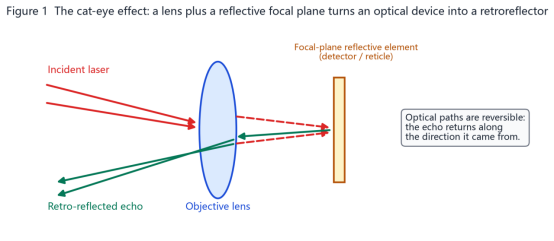
An imaging optical system is, in simplified form, a lens with a reflective surface at or near its focal plane — a detector, a sensor, a reticle. Light entering the objective is focused onto that surface; because optical paths are reversible, the reflected light travels back out through the objective and returns along the direction it came from. This is retroreflection, and in this specific form it is known as the cat-eye effect.
The name is literal. A cat's eye is a focused optical system: the cornea and the crystalline lens act as the focusing lens, while the retina and the tapetum lucidum behind it act as the reflective surface at the focal plane. Light that enters the eye is converged onto that plane and reflected straight back along its original path — which is why a cat's eyes appear to glow in a headlight beam. Nearly every electro-optical observation and aiming device (EOAD) — telescopes, optical sights, low-light night vision devices, cameras — has the same structure: a multi-element lens assembly that behaves like a single lens, with CCD or CMOS imaging detectors or reticles acting as the reflective elements at the focal plane.
The practical consequence is a very large contrast. The echo returned by such a device is typically two to three orders of magnitude stronger than the diffuse return from the surrounding background — and some published studies report up to four. That contrast is the entire basis of detection.
4.2 Active scanning
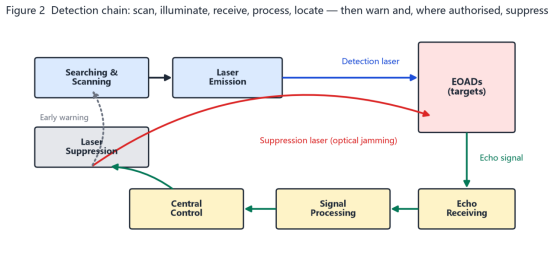
A counter-surveillance system therefore does not wait to be observed. It illuminates:
- A laser — commonly in the near-infrared — sweeps the sector of interest, one instantaneous field of view at a time.
- A camera, mounted coaxially or close to the laser axis, receives the return.
- The system captures paired frames: one with the laser on (active) and one with it off (passive). Subtracting them suppresses the background and leaves candidate bright spots. This active/passive differencing approach has been shown in the literature to be more accurate than single-image detection.
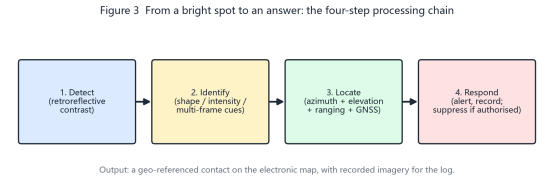
- Candidate spots are scored on shape (roundness, eccentricity), intensity profile, gradient, persistence across frames and behaviour over time — separating real optical targets from glass, polished metal, road signs, vehicle lights and street furniture, which are the main sources of false alarms.
- Once a target is accepted, the system has everything needed to compute a location: azimuth and elevation from the pointing angle at the moment of detection, range from a laser rangefinder or gated return, and its own position from GNSS and a digital compass. The result is a geo-referenced contact shown on an electronic map, with a recorded image for the incident log.
In parallel with the early warning, the same chain can also drive a laser suppression module to impose optical jamming on the confirmed target. Suppression is the step that carries legal and safety obligations: the laser employed must be authorised, classified and operated under the applicable safety rules in the user's jurisdiction.
4.3 Three different questions
It helps to separate the three questions an operator actually asks:
- Is there an optical device out there?— answered by the retroreflective contrast.
- Where is it?— answered by pointing angle + range + own position.
- Is it pointed at us?— the distinctive part. Because the return is directional, a positive detection implies that the optical axis lies within a small angle of the line of sight to the detector. Passive sensors cannot answer this question at all.
5. Active detection vs. passive observation
Active laser detection (cat-eye). Senses the retroreflective signature of the optical device itself. Can give warning before the shot or the image. Needs line of sight; degraded by weather and by countermeasures; reveals its own activity.
Passive infrared / thermal imaging. Senses heat radiated by a person or device; emits nothing and works around the clock. But it is a passive methodology that is easily upset by background heat sources, and it cannot confirm that a lens is aimed at you.
Acoustic gunshot detection. Senses the muzzle blast and bullet shock wave. Mature and useful — but it only works after the shot, and it says nothing about observation.
None of these replaces the others. A serious protective-security design layers them.
6. Where it is used
- Close protection and VIP security.Sweeping the sightlines to a residence, an office, a podium or a motorcade route before and during a movement.
- Critical infrastructure and venues.Airports, ports, energy sites, government compounds and stadiums — either permanently installed or deployed for a specific event.
- Force protection and counter-sniper work.Historically the main driver of the technology: open literature describes laser-based sniper-detection systems fielded from the 1990s onwards, exploiting exactly this effect.
- Indoor counter-surveillance.The same physics at short range — locating pinhole and miniature cameras in meeting rooms and offices, where distances are metres rather than kilometres.
7. Further reading (open sources)
- RP Photonics Encyclopedia, "Retroreflectors" — cat's-eye retroreflector definition: https://www.rp-photonics.com/retroreflectors
- He, Y. Meng and M. Gong, "Active laser detection system for recognizing surveillance devices", Optics Communications 426 (2018) 313–324: https://www.sciencedirect.com/science/article/pii/S0030401818304541
- "Detection of electro-optical peeping devices using laser active detection technology", Chinese Optics — cat-eye target modelling and active/passive difference imaging: https://chineseoptics.net.cn/article/id/9256
- "Active laser detection of cat's eye effect for space-based off-axis three mirror optical system", Optics and Precision Engineering 23(7) (2015): https://ope.lightpublishing.cn/rc-pub/front/front-article/download/1791123/lowqualitypdf/Active%20laser%20detection%20of%20cat's%20eye%20effect%20for%20space-based%20off-axis%20three%20mirror%20optical%20system.pdf
- -L. Song, J. Chang, Y.-F. Zhao and Z.-X. Zhang, "Anti-detection technology of cat eye target based on decentered field lens", Chinese Physics B 27(9) 094220 (2018): https://cpb.iphy.ac.cn/article/2018/1953/cpb_27_9_094220.html
- "Sniper detector based on cat eye effect", Journal of Applied Optics — experimental limits including honeycomb-plate scopes: https://www.yygx.net/article/id/9605
- CN107807453A — polarisation-based anti-laser-active-detection system and method: https://patents.google.com/patent/CN107807453A/zh
- UK CPNI / NPSA, "Hostile Reconnaissance: Understanding and countering the threat" (2016): https://www.cpni.gov.uk/system/files/documents/23/de/understanding-hostile-reconnaissance-understanding-and-countering-the-threat.pdf
- CCW Protocol IV on Blinding Laser Weapons (1995): https://www.un.org/sw/node/181965 — English text: https://treaties.fcdo.gov.uk/data/Library2/pdf/2001-TS0025.pdf
- ICRC statement on the status and operation of Protocol IV (17 November 2011): https://unoda-documents-library.s3.amazonaws.com/Convention_on_Certain_Conventional_Weapons_-_Fourth_Review_Conference_(2011)/MCI_ICRC_ProtocolIV.pdf
- Laser hazard distances, MPE and NOHD: https://laserpointersafety.com/

